

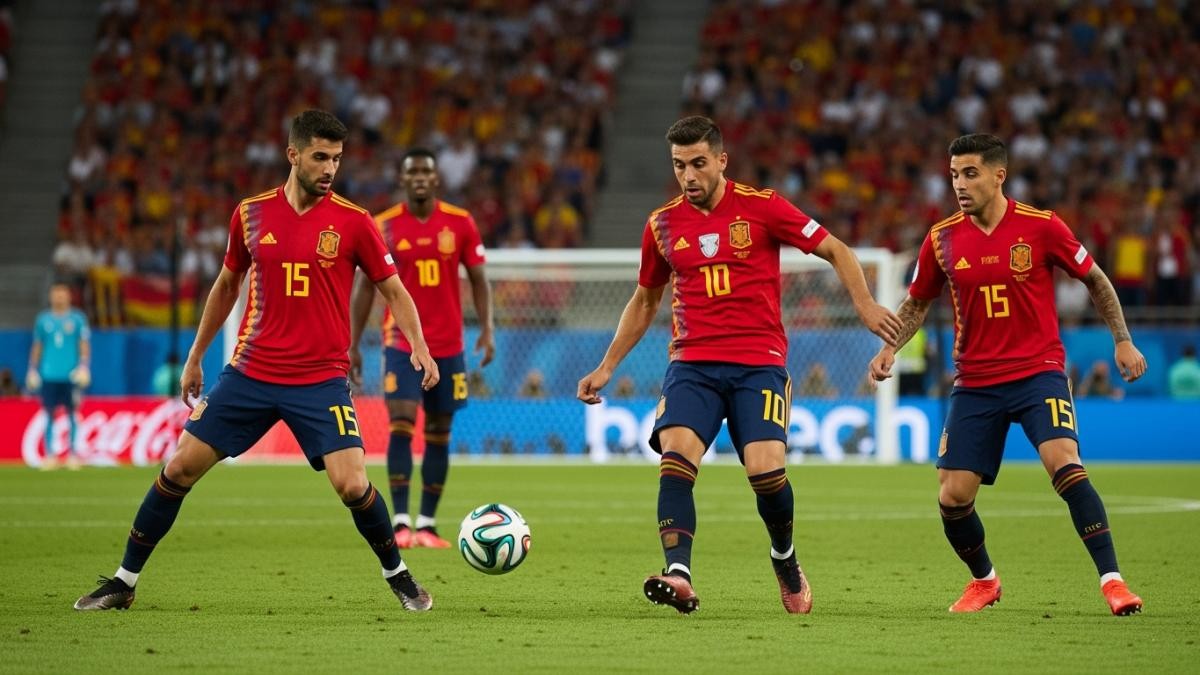
Last night, after watching Spain win the World Cup, something struck me while listening to the post-game analysis.
Someone asked Thierry Henry, the French football legend, former Arsenal striker, and now a FOX Sports analyst, to explain the significance of Spain’s identity and philosophy – their renowned system. His answer was simple, it was, play the same way, at every level, whether it’s a youth team or the World Cup National team. It doesn’t change.
Spain’s Secret: The System Is the Star
The Star is the System
Henry has made this point repeatedly when he talks about Spain and Barcelona: the star is the system. Spain doesn’t build a team around the current talent. They have built a system – the structure, the positioning, the decision-making, that makes every player better, and replaceable without the team losing its identity.
Flip it around and you get the more powerful version of the same idea; the system creates the player. Barcelona’s La Masia and the broader national academy model, doesn’t produce technically gifted players by accident, they produce them because every kid, from age nine on, grows up playing the same positional game. The player isn’t the source of the culture. The culture is the source of the player. While talented players are certainly critical, their individual talent doesn’t drive the strategy. The system, the culture does. Which means the leadership lesson isn’t about talent at all. It’s about culture. Culture produces performance.
The advantage of Spain’s development system is that every level, U-10s through the first team, trains the same positional principles, the same decision rules, the same approach to the game. A promoted player doesn’t have to relearn a system, they already know it. That consistency is what lets players make instant, correct decisions under pressure during a World Cup final, because they’re not deliberating. They’re executing something drilled for a decade.
The leadership Parallel
In hospitals, and other organizations, strategy execution doesn’t just mean the C-suite picks three priorities. It means those are the same priorities a unit manager, a charge nurse, and a frontline clinician would each name, if you asked them one at a time. Cascaded with zero drift, just different applications. When priorities shift by department or are communicated differently or inconsistently, people spend precious seconds in a crisis reconciling competing definitions of “what matters right now.” When they’re consistent and uncompromising, decisions happen the way a well-drilled team’s do, fast, aligned, without a huddle.
This is not a talent story. Spain doesn’t have a monopoly on gifted 19-year-olds. What they have is restraint. In the late 1980s, Spanish football transformed their approach, what they prioritized, and refused to let good talent, good coaches, or poor performance talk them out of it (often attributed to Johan Cruyff who brought Dutch “Total Football” to Barcelona). They stayed uncompromising on that identity through years of criticism and underperformance, even when it would’ve been easy to chase a more direct, physical style that other programs were utilizing to win. That’s the uncomfortable part of uncompromising focus. It isn’t free. It costs you the freedom of chasing whatever’s working elsewhere this quarter.
I think about this every time I sit with an executive team, with a long list of priorities that shift and evolve throughout the year. A list of priorities isn’t a strategy. It’s not being willing to make the call about what is most important. And the cost shows up under pressure, when competing forces pull you in different directions, and when your team doesn’t have time to deliberate. A unit that hasn’t drilled the same two or three things relentlessly will hesitate at the exact moment it can least afford to. Not because the people are unprepared. Because the organization never told them clearly enough what mattered most.
Real focus isn’t a slide in a strategic plan. It’s what a frontline employee can tell you, unprompted, at 2am on a bad night, without checking with anyone first.
Consider your team, your organization, and ask yourself:
If you asked five people on your team to name your top priority right now, would you get five different answers? What about any five leaders or team members in your organization?
What’s on your “priorities” list that’s actually just a list of things you haven’t said no to yet?
Where does your organization’s system break down first under real pressure and what does that tell you about what’s actually been drilled versus what’s just been discussed?
Devon Brown, PhD helps leaders and leadership teams accelerate their impact and transform their organizations. For more than 20 years, Devon has worked with leaders across multiple industries, specializing in healthcare and financial services. Founder of Inciting Leaders, Devon brings a neuroscience-based coaching approach grounded in systems thinking to identify the behaviors and levers that drive the greatest individual and organizational impact. Blending science-backed coaching methods with mindset transformation Devon works helps leaders challenge assumptions, uncover blind spots, and create lasting results in complex, fast-moving environments.

