
As I interviewed the team—which included both young and seasoned employees—I was struck by a recurring theme: “I want more feedback about how I’m doing and greater clarity around expectations.”
In the months that followed, we ensured that the managers spent more time with their direct reports—not just supporting them with their work, but making sure that expectations were clear, roles were identified and named, processes were refined and clarified, and that they were providing feedback, both in-the-moment and in one-on-one coaching sessions. During this time, they started to incorporate new tracking tools to ensure better and timelier communication around deadlines and other targets, and focused their efforts on holding people accountable for missed deadlines and inaccuracies.
Missing the Mark
Despite all of these efforts, as I roamed the halls and continued to meet with team members, I heard the similar refrain: “I don’t get enough feedback and expectations are not clear.” And, while deadlines and accuracy were better, there was still significant room for improvement, and the relationship and interpersonal challenges on the team had not improved.
It occurred to me that maybe the right conversations weren’t taking place.
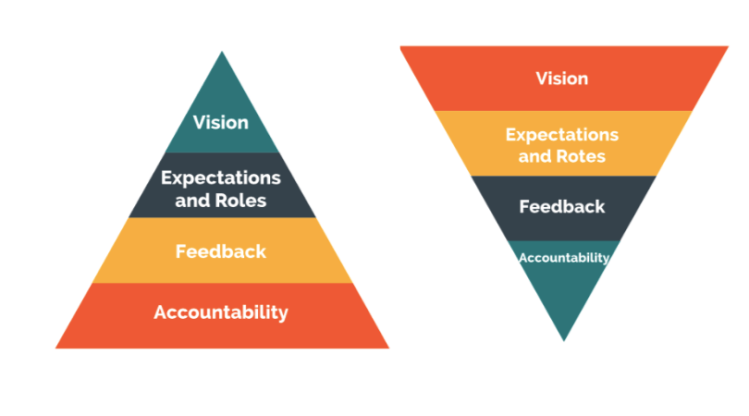
The dynamic that I saw on this team plays out over and over again across a wide variety of industries, functions, and leaders. The simple triangle demonstrates a common mistake that well intentioned leaders often make—they don’t spend enough time clarifying and communicating their team’s vision and direction.
Instead, they focus their attention on feedback and accountability by emphasizing deadlines, quality standards, checks and balances, and addressing flagrant performance problems. This was exactly what was happening with this team, and although these approaches often help they don’t address or solve the real problems, so the undesirable outcomes continue to flare up.

When team members are unclear about vison and direction, it’s much harder for them to intuitively understand how they fit into the team, how they can contribute best, and ultimately the parameters of their role and what is expected of them. Instead, they rely on general agreed upon assumptions about why the team exists—mostly couched around what the team is expected to deliver and its goals.
As a result, we find that leaders have to keep coming back toquestions around expectations and roles, and ultimately focus a disproportionate amount of time on feedback and accountability.
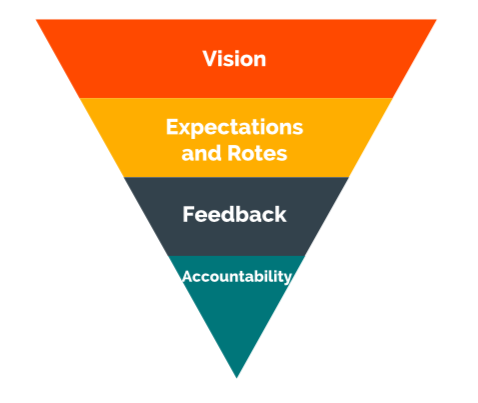
Let’s Try Turning the Triangle Around
When leaders are clear about vision—why the team exists, what value they provide their customers, and how they will accomplish their work—and they get buy-in to this vision, they need to spend less time communicating around expectations and roles. That’s not to say that leaders don’t need any clarity around this, but if team members fully understand how they, individually and as a team, support their internal and external customers, and are involved in discussions around how to accomplish this, they will more intuitively understand what’s expected of them and have better role clarity.
When this is true, they also don’t need as much feedback from their manager, since they have played an active role in the creation of what they’re working on and what it takes to be successful.
How Great Leaders Inspire Action
A simple set of questions can help ensure clarity around vision. As a team leader, you must be crystal clear about these questions:
1. WHY do we exist?
2. WHO cares if we succeed or fail?
3. HOW do we distinguishes ourselves?
4. WHAT do we provide?
A great resource and kick starter for thinking about the core essence of vision and the teams’ value proposition is Simon Sinek’s TED Talk “How Great Leaders Inspire Action.”
Having conversations within a team or department about these four questions, and clarity about how the team answers them, is an engaging and valuable use of time, and a critical first step in flipping the triangle.
Written by Devon Brown, PhD. Originally published as a Linkage Insight Brief.
 Inciting Leaders